Project Build · Washington State · Road Trip · Open Data · April 2026
🔍 Plate Hunter: Washington's 72 Specialty Plates as a Road Trip Game
Live App · brooksgroves.com/plate-hunter ↗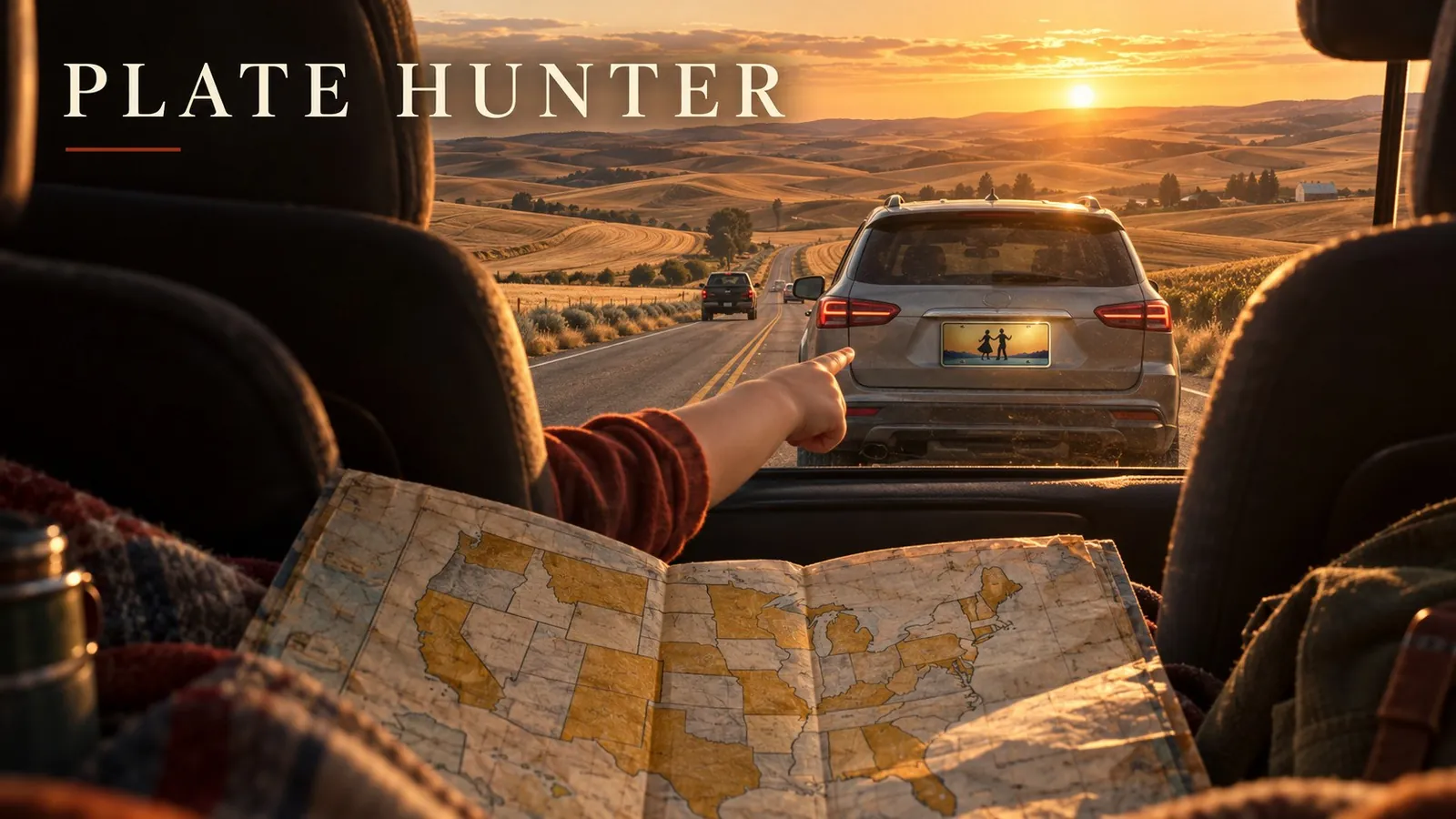
On April 20, 2026, the Seattle Times ran a data story about Washington specialty license plates. Gene Balk had pulled the DOL's annual registration report and found that in 2025, nearly 184,000 vehicles in the state carried a special-design plate, generating $5.8 million in fees. He listed the top sellers (WSU with 24,100 plates, the Seahawks with 11,100) and then buried the best part in the last paragraph.
Update, October 2026: Plate Hunter grew up. It now covers every US state, every Canadian province and territory, every Mexican state, and more than 8,000 specialty plates, all checked against the licensing agencies' current lists, with a little robot that watches for new ones. The story of how that happened is at the end, in Six Months Later. Play it here.
"The least popular special-design plate last year was the square dancer design, on only five vehicles, despite being one of the least expensive." — Seattle Times, April 20, 2026
Five square dancer plates on the roads of Washington State. I read that and knew there was an app in it.
Washington has 72 specialty license plates, and most people driving around this state have never noticed most of them. There's a plate for pickleball and one for honeybees. There's a plate for the Muckleshoot Tribe, and one that's only legal on vehicles built before January 1, 1916. And somewhere on I-5 or the back roads of the Palouse, five vehicles are rolling around with a square dancer on the bumper, worth 300 points to whoever's paying attention.
PLATE HUNTER is a road trip game built on that. See a plate in real life, tap it in the app, and it unlocks in full color and earns you points. The rarer the plate, the more it's worth, and the rarity tiers come from actual DOL vehicle registration counts instead of difficulty levels I made up.
The Data Behind It
The Seattle Times article came out the same morning I started building. The DOL's 2025 figures gave me what I needed for a proper rarity system:
| Rank | Plate | Vehicles | Fees |
|---|---|---|---|
| 1 | WSU Cougars | 24,100 | $734,000 |
| 2 | Collector Vehicle | 20,300 | $710,400 |
| 3 | Washington National Parks | 12,700 | $404,000 |
| 4 | Law Enforcement Memorial | 11,300 | $351,100 |
| 5 | Seattle Seahawks | 11,100 | $336,000 |
| — | Seattle Mariners | 1,100 | $35,300 |
| — | Seattle University | ~200 | $6,600 |
| — | Horseless Carriage | ~140 | — |
| 💀 Last | Square Dancer | 5 | — |
That data maps onto four rarity tiers: Common (8,000+ vehicles, 10 pts), Uncommon (3,000–8,000, 25 pts), Rare (500–3,000, 50 pts), and Legendary (under 500, 150–300 pts). WSU is Common; you'll see it constantly. The square dancer is Legendary at 300 points, the most in the game, because there are five of them.
The Image Source
The plate images came from two places. The base catalog of 67 plates came from Jon Keegan's us-license-plates repository, a dataset of all 8,291 U.S. license plates collected in 2023 for his Beautiful Public Data project. It's great open data work: every specialty plate from all 50 states, cleanly organized, photographed and licensed.
The 2025 additions (Pickleball, Honeybees & Pollinators, Keep WA Evergreen, LeMay Car Museum, Throwback Blackout) came straight from the Washington DOL's special design plates page. Two more are pending: Smokey Bear ("coming soon") and Mount St. Helens ("awaiting redesign after the first one failed testing"). They'll be added when they drop. The update pipeline is simple: find the DOL image, drop it in plates/WA/, add one JSON entry, push.
The Architecture
This is the plainest project in this collection, on purpose. There's no Python, no GitHub Actions cron job and no data pipeline. The whole thing is one HTML file and a folder of images.
plate-hunter/
├── index.html       ← The entire app
├── README.md
└── plates/
    └── WA/          ← 72 plate images, static files
        ├── seahawksPlate.png
        ├── squaredancePlate.png
        └── ...
Plate data lives as a JSON array inside index.html. The app renders the grid from that array, loads images via relative paths, handles tap/collect interactions with vanilla JavaScript, and saves found plates to localStorage. No build step, bundler or framework. GitHub Pages serves it for free, and deploying is a git push.
Work in Progress
Washington is where it starts. The bigger plan: all 50 states using Keegan's dataset, Canadian provinces and Mexican states as bonus tiers, React Native for iOS and Android, and a family multiplayer mode. There's a lot of road between here and there.
The core game already works, though. The real plate photos load, the rarity tiers come from real counts, and confetti fires when you find something good. Somewhere in Washington, five square dancer plates are waiting to be tapped.
Six Months Later: Every State, Canada and Mexico
That "Work in Progress" list turned out to be a to-do list. Here's where Plate Hunter stands in October 2026.
| What | Then (April) | Now (October) |
|---|---|---|
| Places | Washington | All 50 states and DC, Canada's 10 provinces and 3 territories, and Mexico's 32 states |
| Specialty plates | 72 | 8,099 |
| Checked against the agency's current list | 1 state | Every state, province and territory |
| With the official plate artwork | 72 | more than 7,900 (97%) |
| Keeping it fresh | Me, by hand | A robot, twice a week |
Two games in one
Every road trip already plays the classic version: spot a plate from every state before you get home. So the app now opens on a US map that fills in gold as you go, with a list of every state's everyday plate underneath. Tiny states like Rhode Island and Delaware get their own tap-friendly buttons beside the map. Start a new trip whenever you set off again, and the states you've ever seen are kept.
The specialty hunt is still the deep cut, and it's the same game as in April: see a plate, tap it, earn the points. Washington's points still come from how many cars really carry each plate. Everywhere else, every plate is worth the same until I find counts for those states too.
From one state to all of them
Jon Keegan's 2023 dataset was the starting point for every state, just like it was for Washington. But a 2023 snapshot can't know about plates that came out in 2024, 2025 and 2026, so I went back to each licensing agency's own catalog and compared, state by state. That turned up about 750 plates newer than the snapshot: new universities, new sports teams, America's 250th anniversary plates in several states, and a lot of plates the snapshot had simply missed.
Some of those catalogs were easy to read. Others only exist inside a web page that builds itself as you scroll (Texas's My Plates, Arizona, Kentucky), and a few, like Maryland's 777-entry list of organization plates, run forty pages deep. Those I read in a real browser, page by page. North Carolina keeps its plate store behind a login, but its public order forms list every plate it sells, which turned out to be just as good.
Plates a state no longer sells stay in the game. They're still out there on older cars, so they keep their place with a quiet note: "No longer sold, still on the road." When a plate merely went missing from a catalog, without any sign it was retired, I left it alone. Texas's Choose Life plate and North Carolina's NASCAR driver plates are still very much hunt-able.
Only the real pictures
Every plate picture comes from the licensing agency or the plate's own sponsor, never a photo of someone's car. Every new picture gets a look before it goes in, and a few have come back out: a "Plate Coming Soon" placeholder, a sheet of four tiny plates, one with a photo-sharing watermark across it. Those plates show a drawn stand-in with the plate's name until a proper picture turns up.
One fun wrinkle: Illinois's website won't talk to the servers that download pictures for the game. It talks to a person in a normal browser just fine, though. So I opened the site in Chrome, ran a small script that saved all 48 missing Illinois pictures, and dropped them into the project by hand. Every Illinois military and veteran plate now shows the state's own artwork.
A robot that watches for new plates
New plates come out all the time, so Plate Hunter now has a little robot that runs on GitHub every Monday and Thursday. It visits 83 agency pages, compares every plate picture it finds with the ones already in the game, and opens an issue listing anything new. I reply /add or /skip, and it does the rest: adds the plate, downloads the picture, and gives it a NEW badge in the app for 60 days.
And then, Canada
The April plan said "Canadian provinces as bonus tiers," and that's live now too. A USA / Canada switch on the map flips to all 10 provinces and 3 territories, each with its own count, so one road trip can cover both. The specialty hunt adds 141 Canadian plates: 69 from Ontario (Leafs, Raptors, Blue Jays, universities and regiments), Manitoba's Jets and Blue Bombers, Saskatchewan's Rider Pride, Alberta's Oilers and Flames, B.C.'s Parks plates, and Prince Edward Island's wildlife conservation series with a red fox, a blue jay and a lady's slipper.
My favorite find of the whole project is Canadian, too: Nunavut's everyday plate is shaped like a polar bear. The Northwest Territories has driven around on a bear-shaped plate since 1970, and in 2025 Nunavut brought back a polar bear of its own.
¡Y México también!
Mexico made it the same day. A third button on the map brings up all 31 Mexican states and Mexico City, so a trip down the Baja or across the border counts too. Mexican plates work a little differently: each state redesigns its plate every few years, and old designs often stay legal for a while, so the hunt there is for designs on the road: the current plate, the one before it, World Cup 2026 plates in five states, and the green "eco" plates for electric and hybrid cars. Official pictures are scarce, so most Mexican plates start as drawn stand-ins for now, and I'll keep filling them in.
What changed under the hood
The April build was one HTML file. It's still no framework and no build step, and GitHub Pages still serves it for free. But the plates now live in one data file per state or province, a handful of small Python scripts check and update them, and GitHub Actions runs the robot and downloads pictures. The app works with no signal, and it installs to your phone's home screen like a real app.
Still on the list
A true App Store and Play Store version for road trips. Rarity points for more states, as I find registration counts. Pictures for the last few plates that don't have one yet, especially in Mexico. The square dancer is still out there, and now so is a polar bear.
Open source at github.com/bdgroves/plate-hunter. Live app at brooksgroves.com/plate-hunter. Built in Lakewood, WA.
Brooks Groves · April 2026, updated October 2026