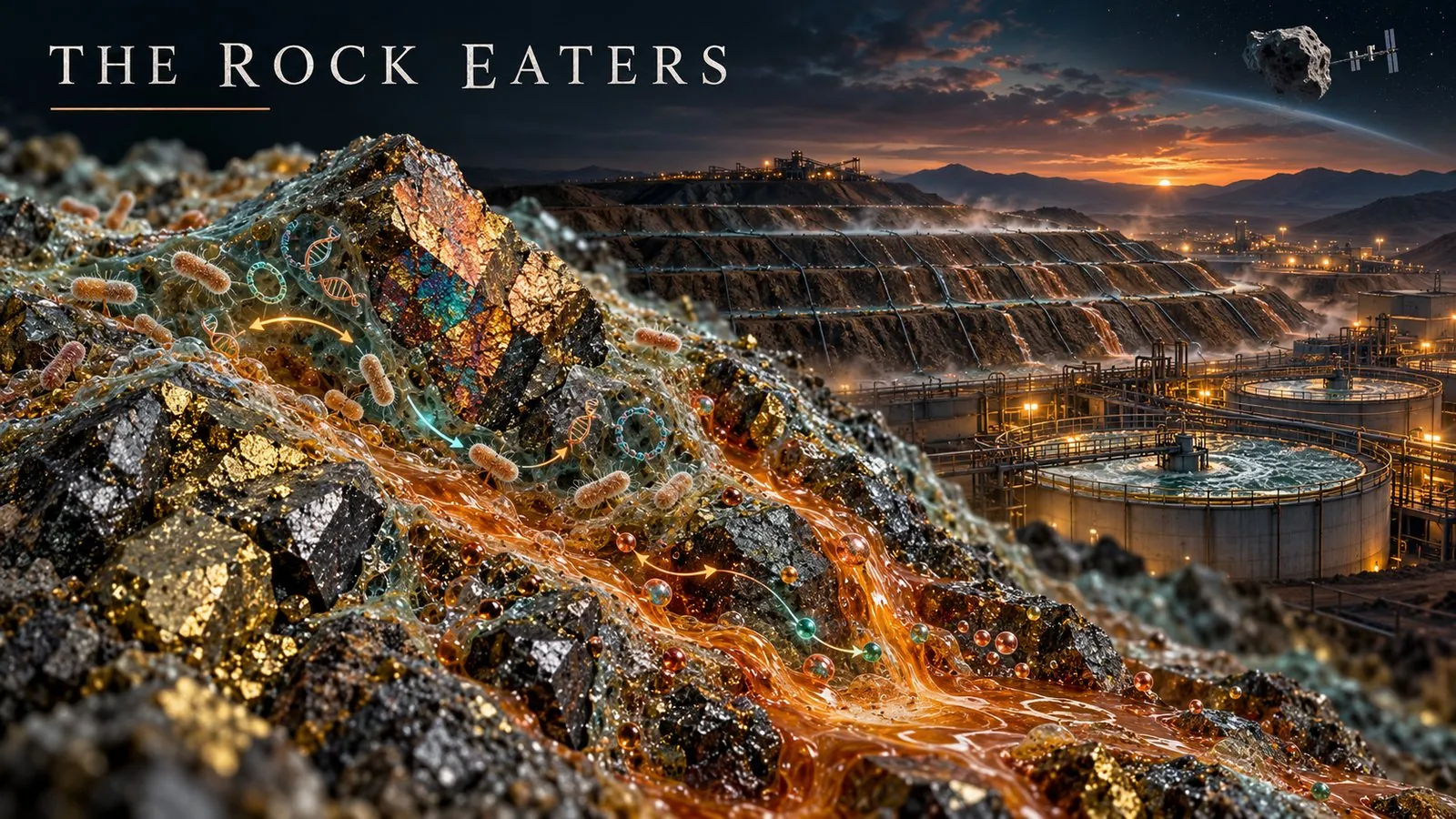
Somewhere in a copper heap in Chile right now, more bacteria than there are stars in the galaxy are eating iron and making sulfuric acid, and in the process they are taking a mountain apart one molecule at a time. Nobody feeds them metal. Nobody asked them to. They just do it, the way they have been doing it in acid springs and weathering sulfide rock for far longer than there have been mines. In 1996 I spent time at the University of Cape Town with Doug Rawlings, one of the people who figured out how to put these rock eaters to work. Thirty years later they are pulling copper, nickel and gold out of rock on four continents, and they may be just getting started.
Cape Town, 1996
The work was on acidophiles: microbes that thrive in acid strong enough to dissolve metal, and in particular the ones that make their living by oxidizing iron and sulfur. Most life would die in their world. They need no sunlight and no sugar, just rock, water and air. I was a couple of years out of molecular biology at the University of Nevada, Reno, and they fascinated me. To a microbiologist they were a window into how strange life can get. To a mining engineer they were a tool that might, just might, replace a smelter.
Doug was one of the people who saw both sides. He trained as a microbiologist at Rhodes University and spent more than twenty-five years at the University of Cape Town and Stellenbosch University. Stellenbosch later called him “one of the first molecular microbiologists in South Africa.” From the late 1980s his group studied the microbes behind biomining, down to their genes and the small rings of DNA, plasmids, they pass between each other.
Those were the years of South Africa’s brain drain. Researchers at UCT later counted 41,496 professionals who emigrated between 1989 and 1997, about four times the official number. As I remember it, Doug was part of that for a while, leaving for Australia and then coming back. By 1998 he had a big job: from that year he was Professor and Chair of Microbiology at Stellenbosch, and he later served the university as acting dean of science and acting vice-rector for research.
How bacteria mine
Here is the trick, and it is a beautiful one. Many valuable metals sit in the ground as sulfide minerals: copper in chalcopyrite, nickel in pentlandite, gold locked inside pyrite and arsenopyrite. Ferric iron and acid will slowly eat those minerals away. The catch is that the reaction uses up the ferric iron and stalls.
That is where the bugs come in. Iron-oxidizers like Acidithiobacillus ferrooxidans and Leptospirillum turn the spent ferrous iron back into ferric iron, and sulfur-oxidizers turn sulfur into sulfuric acid. They live in a thin slime on the mineral surface and keep the reaction running for as long as you feed them air. The microbes don’t eat the metal. They keep the acid bath working, and the energy they skim off that chemistry is their whole living. Think of them as tiny batteries charging themselves on the rock, and dissolving it as a side effect.
There are two ways to use it. In bioleaching, the metal you want, copper or nickel, dissolves into the liquid and gets recovered from there. In bio-oxidation, used for gold, the bacteria eat away the sulfide that traps tiny grains of gold, and the gold stays behind in the solid, ready for the usual cyanide process.
The bug I learned as Thiobacillus ferrooxidans got a new name in 2000: Acidithiobacillus ferrooxidans. And one of Doug’s contributions was showing it often isn’t the main worker at all. His group found that in the big commercial tanks, Leptospirillum-type bacteria usually do most of the iron oxidizing.
South Africa built the first tanks
Copper miners had been using bacteria in their waste dumps since the 1950s, often without meaning to. The first plant designed from the start around the microbes treated gold, and it was in South Africa. Gencor’s mining division developed a process called BIOX, and in October 1986 it began treating gold concentrate at the Fairview mine near Barberton, which still calls itself the birthplace of BIOX. Doug’s biography says he was involved in the initial conceptual development of the process for bio-oxidizing gold-bearing arsenopyrite, the stubborn ore it was built for.
Picking the right microbes mattered. Selecting better cultures cut the time ore spent in the Fairview tanks from more than twelve days to about three and a half. BIOX went on to plants in Ghana, Australia and elsewhere: thirteen in all, which together have produced more than 25 million ounces of gold. The technology now belongs to Metso.
Microbiology and mining engineering, before either field fully knew what to do with the other.
How far it has come
In 1996 the field was still proving itself. Since then the rock eaters have gone big.
Copper, by the mountain. In Chile, low-grade copper ore is stacked in heaps the size of hills and left to the microbes. BHP began bioleaching sulfide ore in dumps at Escondida, the world’s biggest copper mine, in 2006. One 2022 review estimated that in 2010 bioleaching accounted for as much as 42% of the copper Chile recovered by leaching, about 16% of all its copper. The same review notes that no one has a current global figure, and that as Chilean mines turn to other processes, the share from bioleaching there has fallen.
Nickel for batteries. In Finland, Terrafame heap-bioleaches nickel ore and turns it into battery chemicals. The company says bioleaching uses about 90% less energy than conventional processing, and that its plant makes enough nickel sulfate for about a million electric cars a year.
Reading the microbes’ DNA. In the 1990s, studying these bacteria mostly meant growing them in the lab, one kind at a time. In 2004, a team sequenced DNA straight out of a slimy biofilm in the acid drainage of Iron Mountain, California, and pieced together near-complete genomes for two of the microbes living there, and partial genomes for the rest. It was one of the first studies of its kind. Now researchers can read the whole community in a heap and watch who is doing the work.
A new copper process in Arizona. Rio Tinto’s Nuton technology, built on decades of research, produced its first copper in November 2025 at the Johnson Camp mine in Arizona. It grows its own microbes on site, recovers up to 85% of the copper from ore that was once hard to leach, and makes pure copper cathode without a smelter.
New metals, old waste. Startups such as Endolith are using microbes and machine learning to leach copper and other critical minerals. Researchers at Cornell are engineering bacteria to dissolve the rock that holds rare earth elements. Others are bioleaching old lithium-ion batteries to recover their metals. Even mine tailings, once just waste, are starting to look like ore again.
What comes next
Here is where it gets fun. The next chapter of biomining reads a little like science fiction, except that most of it has already happened in a lab, and some of it in orbit.
Mining in space. In July 2019, a SpaceX rocket carried eighteen matchbox-sized reactors to the International Space Station. The experiment, called BioRock, came from Charles Cockell’s team at the University of Edinburgh with the European Space Agency. Astronaut Luca Parmitano ran the reactors for about three weeks: some in plain microgravity, others in a small centrifuge that simulated Mars and Earth gravity. A bacterium called Sphingomonas desiccabilis pulled rare earth elements such as neodymium and cerium out of basalt, and it worked just as well in microgravity and Mars gravity as it did at Earth gravity. A follow-up did the same for vanadium, a metal used to harden steel. “You can think of microbes as miniature miners, if you like,” Cockell told CBC radio. Then in early 2026 came the results from BioAsteroid, flown in 2020: on fragments of a meteorite aboard the station, a fungus boosted the release of palladium and platinum. Picture a future Mars base that grows its own mining crew from a starter culture, the way a baker keeps sourdough.
Designer microbes. Back on Earth, biologists have started editing the miners. At Cornell, Buz Barstow’s lab works with Gluconobacter oxydans, a bacterium that makes an acid able to dissolve the ore that holds rare earths. The team switched off 2,733 of its roughly 3,300 genes, one at a time, to see which ones mattered. Breaking a single gene for a phosphate transporter made it 18% better at leaching. A later screen found one change that more than doubled how much neodymium it pulled out. Cornell is now building a “microbe-mineral atlas” with $2 million from the National Science Foundation. They’re honest about where things stand, though: no known microbe is ready yet to mine these energy-critical metals at commercial scale.
Biology may also help with the hardest step after mining. Rare earths are chemical twins, and separating them usually takes dozens to hundreds of rounds of solvent extraction. In 2023 a Penn State team led by Joseph Cotruvo, working with Lawrence Livermore, showed that a version of a protein called lanmodulin, from a bacterium found on English oak buds, can separate neodymium from dysprosium in a single step, at room temperature, with no organic solvents. That isn’t leaching, but it is the same idea: let evolution do the chemistry.
The waste is the ore. The world’s disclosed tailings dams hold about 44.5 billion cubic meters of ground-up rock, and mining adds something like 9 to 14 billion tonnes more every year. That material has already been dug up and ground fine, which is exactly what a microbe wants. In Uganda, an operation at Kasese used bacteria to recover cobalt from old copper tailings. A 2025 study in Science from the Colorado School of Mines found that recovering less than 10% of the cobalt already lost to waste at US mines could supply the entire US battery market. And then there is e-waste: 62 million tonnes of it in 2022, only about a fifth of it documented as recycled, holding an estimated $91 billion in metals, including about $15 billion in gold.
The honest part. Biomining isn’t automatically green. It shares a lot of energy-hungry steps with ordinary mining, and its biggest wins come when it lets you skip steps entirely: heaps skip the fine grinding and the smelter, and dumps of run-of-mine rock skip the crushing too. The microbes are also slow: a copper heap can take one to three years to give up its metal, and a waste dump far longer. Chalcopyrite, the most common copper mineral, tends to coat itself in a crust that stalls the reaction. In Finland, metal-laden water once escaped a storage pond at Talvivaara, the mine Terrafame later took over, after heavy rain overwhelmed a pond that was badly designed and overloaded. And in Chile the microbes now have competition: BHP is testing chloride and nitrate leaching, and weighing a chemical catalyst, alongside its bioleach at Escondida, and Codelco’s new $1.3 billion plan for its Radomiro Tomic mine uses chloride. The rock eaters will have to keep earning their place.
I like their chances. They have been doing this far longer than we have.
Remembering Doug
Doug Rawlings died on May 2, 2020, at 68. He edited the books the field still learns from, Biomining in 1997 and a second Biomining with Barrie Johnson in 2007. He was president of the Royal Society of South Africa and a founding member of the Academy of Science of South Africa. The Academy’s tribute includes my favorite detail: he rode his first Cape Argus Cycle Tour on his son’s school bike, then rode twenty-one more.
I went on to Seattle in 1997 and, eventually, to maps. But every time I read about a copper heap in Chile, or a battery plant in Finland, or a new copper cathode in Arizona, I think of those acid-loving bugs in Cape Town, and of Doug, who did so much to show they would matter.
Go deeper
Microbes Mining Mars Minerals — BacterioFiles, American Society for Microbiology, 2021. The BioRock vanadium experiment.
Microbes may be our miners on asteroids, moons and other planets — Quirks & Quarks, CBC, 2020. Bob McDonald talks with Charles Cockell.
Why biomining might finally work — Interchange Recharged, Wood Mackenzie, 2026. With Liz Dennett of Endolith.
The microbial solution to our massive copper shortfall — The Green Blueprint, Latitude Media, 2026. Also with Liz Dennett.
Biotechnology for Exploration, Extraction, and Remediation — UBC BRIMM webinar, 2020. Five short talks, from metagenomics to acid mine drainage.
Rawlings, D.E. (2005). Characteristics and adaptability of iron- and sulfur-oxidizing microorganisms used for the recovery of metals from minerals and their concentrates. Microbial Cell Factories 4, 13. — Doug’s own readable tour of the microbes, free to read.
Rawlings, D.E. & Johnson, D.B., eds. (2007). Biomining. Springer.
Roberto, F.F. & Schippers, A. (2022). Progress in bioleaching: part B, applications of microbial processes by the minerals industries. Applied Microbiology and Biotechnology.
van Niekerk, J. et al. (2023). Bioprocessing of refractory gold ores: the BIOX, MesoTHERM and ASTER processes. In Biomining Technologies, Springer.
Johnson, D.B. (2018). The evolution, current status, and future prospects of using biotechnologies in the mineral extraction and metal recovery sectors. Minerals 8, 343. — Free to read, and the most honest look at the carbon question.
Cockell, C.S. et al. (2020). Space station biomining experiment demonstrates rare earth element extraction in microgravity and Mars gravity. Nature Communications 11, 5523. — BioRock, free to read.
Schmitz, A.M. et al. (2021). Generation of a Gluconobacter oxydans knockout collection for improved extraction of rare earth elements. Nature Communications 12. — The Cornell gene-by-gene screen.
Mattocks, J.A. et al. (2023). Enhanced rare-earth separation with a metal-sensitive lanmodulin dimer. Nature 618.
Mining rocks in orbit could aid space missions — University of Edinburgh, 2020. · Microbe atlas could reveal how to mine critical metals sustainably — Cornell Chronicle, 2024.
Can bacteria serve as “microscopic miners” of the metals we need? — Alexander C. Kaufman, Mother Jones, 2025.
Obituary — Stellenbosch University. · In Memoriam — Academy of Science of South Africa.
Rio Tinto’s Nuton technology produces first copper (December 2025). · Fairview mine, birthplace of BIOX — Pan African Resources.